

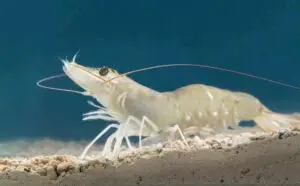
Our first research into the welfare of farmed shrimp is now under way in Egypt, supported by the Arthropoda Foundation.
Shrimp are among the most farmed animals on the planet. Pacific white shrimp (Litopenaeus vannamei) alone are produced in their billions every year, yet their welfare has attracted very little attention. As Egypt’s aquaculture sector grows, and as more tilapia farmers move into higher-value shrimp, we have a real opportunity to build welfare into the way these animals are raised and harvested from the outset.
That is why we have launched two small research projects, both supported by the Arthropoda Foundation. They represent our first official foray into the wonderful world of crustacea, and a significant step in bringing shrimp into the welfare conversation in Egypt and across Africa.
What does shrimp welfare actually look like?
Most people have a clear picture of what good welfare means for a farm animal on land. For shrimp it is far less obvious. A useful way in is to look at where they live. Farmed shrimp are usually kept in ponds and tanks with bare bottoms and little structure, which leaves them nowhere to shelter and little to do. Something as simple as adding substrate to a barren tank, so shrimp can burrow and forage the way they would in the wild, can make a real difference.
Project one: environmental enrichment
The first project examines the potential for introducing environmental enrichment for farmed shrimp in Egypt. Working across commercial ponds in Kafr El-Sheikh, we are comparing conventional barren systems with enriched ones that mimic features of the shrimp’s natural habitat:
- a layer of sand and gravel that lets them burrow and forage
- shelter pipes that give cover during moulting, when they are soft and vulnerable
- demand feeders that let shrimp trigger their own feed, easing the competition and aggression that come with broadcast feeding
Using underwater cameras, we are recording how the shrimp actually behave, then measuring outcomes such as survival and physical condition. Because shrimp are farmed in such vast numbers, even a small improvement scales into better lives for millions of animals, and better survival is a direct incentive for farmers to take these changes on.
Project two: a kinder harvest
The second project focuses on the use of ice slurry as a more humane way to slaughter shrimp. The usual method in Egypt is to lift shrimp from the pond and pack them in dry ice, where death comes slowly through a mix of oxygen loss and cold. It can take more than fifteen minutes, with little attention to their suffering during slaughter.
Immersing shrimp in an ice and water slurry instead brings on loss of sensibility within seconds. The reason it is not already standard is not cost or complexity, but the market. Slurry can turn the muscle opaque, and buyers read that whitening as a sign of poor freshness. Our trial is developing a precise protocol that achieves a fast, humane death while keeping the translucent appearance the market expects, so that doing right by the animal and selling a good product no longer pull in opposite directions.
What comes next
These two projects are only the beginning. Decapod crustaceans are increasingly recognised as sentient animals capable of feeling pain and stress, and there is a great deal we still do not know about how to give them a good life. We will share results as they come in. For now, we are glad to be helping bring shrimp, so long overlooked, into the welfare conversation.
Want to support this work?
Shrimp welfare research is in its infancy, and there’s much more to discover. Your support helps us develop the science and practical solutions needed to improve the lives of billions of animals. Donate here or sign up to our newsletter to stay informed about our progress.